
Display Technology
How to Choose an Industrial TFT LCD Display
Learn how to select an industrial TFT LCD display by evaluating size, resolution, brightness, viewing angle, interface, touch technology, operating temperature, mechanical dimensions and customization requirements. This guide helps engineers and purchasing teams identify a suitable display solution for industrial equipment and HMI applications.
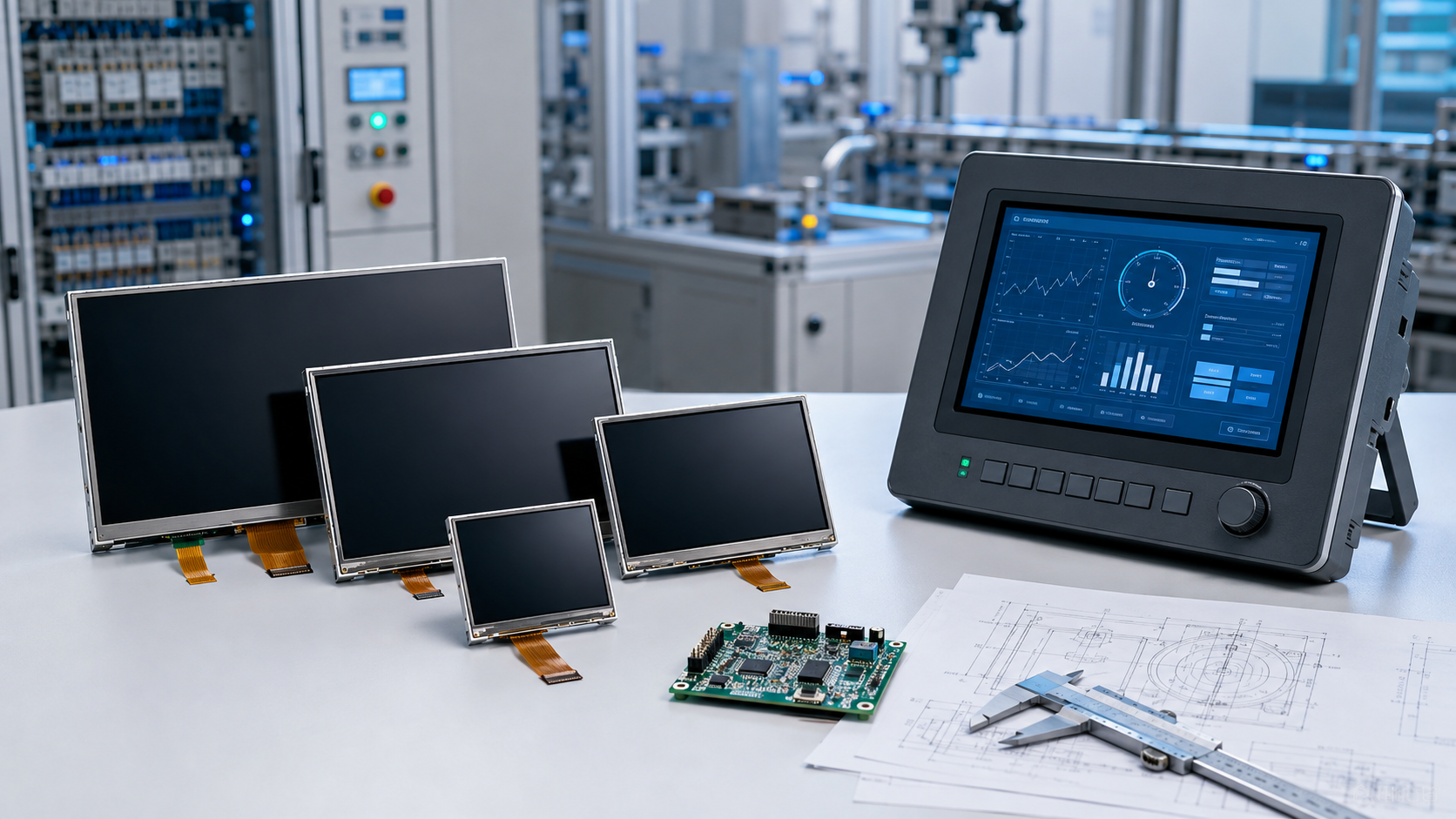
How to Choose an Industrial TFT LCD Display
Industrial TFT LCD displays are widely used in factory automation, HMI terminals, measurement instruments, medical equipment, transportation systems, charging stations and outdoor control devices. Unlike consumer displays, industrial displays must operate reliably under demanding environmental and electrical conditions.
Selecting the right industrial TFT LCD requires more than choosing a screen size. Engineers should evaluate optical performance, interface compatibility, temperature range, touch requirements, mechanical dimensions and long-term supply.
1. Define the Application Environment
Start by identifying where and how the display will be used. Important questions include:
Will the equipment be installed indoors or outdoors? Will the display be exposed to direct sunlight? Is the environment affected by vibration, dust or moisture? What operating-temperature range is required? How many hours per day will the display operate? Is long-term product availability required?
A factory HMI, outdoor charging station and handheld instrument may require completely different display configurations.
2. Select the Display Size and Mechanical Dimensions
The display size must match both the user-interface requirements and the available installation space. Common industrial TFT LCD sizes include 2.4, 3.5, 4.3, 5.0, 7.0, 8.0, 10.1 and 12.1 inches.
Do not evaluate only the diagonal size. Confirm the following mechanical specifications:
Module outline dimensions Active area Viewing area Display thickness FPC position and length Mounting structure Connector location Touch-panel and cover-glass dimensions
A display with the correct diagonal size may still be unsuitable if its outline dimensions or FPC position do not match the enclosure.
3. Choose a Suitable Resolution
Resolution determines how much information can be displayed and how clearly text, icons and graphics appear. The correct resolution depends on the screen size, graphical interface and processor performance.
Common resolutions include:
320 × 240 480 × 272 800 × 480 1024 × 600 1280 × 800 1920 × 1080
Higher resolution can improve image detail, but it also requires greater graphics-processing capability, memory bandwidth and data-transfer speed. The resolution should therefore be selected together with the main controller or processor platform.
4. Evaluate Brightness and Outdoor Readability
Brightness is normally measured in cd/m², also called nits. Indoor industrial equipment may use standard brightness, while outdoor or high-ambient-light applications usually require a high-brightness display.
Outdoor readability is affected by more than brightness. Engineers should also evaluate:
Cover-glass reflection Surface treatment Optical bonding Contrast under ambient light Backlight power consumption Heat dissipation
Anti-glare treatment and optical bonding may improve readability by reducing internal reflections. Final brightness requirements should be confirmed under the actual operating environment.
5. Confirm Viewing Angle and LCD Mode
The viewing-angle requirement depends on the installation position and how users interact with the equipment.
TN displays may be suitable for cost-sensitive applications with a fixed viewing direction. IPS displays generally provide wider viewing angles and more consistent color performance, making them suitable for industrial HMIs, medical equipment and devices viewed from multiple directions.
Confirm whether the display will be viewed from the front, above, below or from the side before selecting the LCD mode.
6. Match the Display Interface
The display interface must be compatible with the customer’s processor, controller board and software platform. Common TFT LCD interfaces include:
RGB LVDS MIPI DSI SPI MCU HDMI through a controller board
Small displays may use SPI or MCU interfaces, while medium-size embedded displays commonly use RGB or MIPI. Higher-resolution industrial displays may use LVDS or other high-speed interfaces.
Engineers should confirm interface type, voltage level, pin definition, connector type, timing requirements and cable length before approving the display.
7. Select the Touch Technology
Industrial TFT LCD modules can be supplied without touch, with resistive touch or with projected capacitive touch.
Resistive touch can be operated with a finger, glove or stylus and may be suitable for traditional industrial control equipment.
Projected capacitive touch supports modern multi-touch operation and can provide a clear, durable user interface. Its performance may be customized for cover-glass thickness, glove operation, water tolerance and electromagnetic compatibility.
Confirm the touch interface, controller IC, cover-glass design, bonding method and operating environment during the design stage.
8. Check the Operating-Temperature Range
Consumer displays may not be suitable for equipment exposed to low or high temperatures. Industrial applications often require an extended operating-temperature range.
Verify both:
Operating temperature Storage temperature
Temperature can affect response time, brightness, liquid-crystal performance, backlight life and touch operation. The final display should be tested under the expected temperature conditions of the complete equipment.
9. Consider Optical Bonding and Cover Glass
Air bonding is suitable for many standard indoor applications. Optical bonding places a transparent bonding material between the TFT LCD and touch panel or cover glass.
Potential benefits of optical bonding include:
Reduced internal reflection Improved sunlight readability Better mechanical strength Reduced condensation between layers Improved visual appearance
Cover glass can also be customized for thickness, shape, printed border, logo, holes, surface treatment and hardness requirements.
10. Evaluate Reliability and Long-Term Supply
Industrial projects often remain in production for many years. Product availability, component-change control and manufacturing consistency are therefore important selection factors.
Before approving a display, confirm:
Product lifecycle expectations Sample and mass-production availability Change-notification process Quality-control requirements Reliability testing Technical documentation Production traceability
The selected display should support both the technical requirements and the expected production lifecycle of the customer’s equipment.
11. Prepare the Required Information for a Custom Display
Providing complete project information helps the display manufacturer evaluate the solution efficiently. A useful request should include:
Required display size Resolution Interface Brightness Viewing angle Touch requirement Operating and storage temperature Outline-dimension limitations FPC and connector requirements Cover-glass drawing Expected annual quantity Application and installation environment Prototype and mass-production schedule
If an existing display must be replaced, provide the current datasheet, mechanical drawing, photos and any known problems.
Conclusion
Choosing an industrial TFT LCD display requires a balanced evaluation of optical performance, electrical compatibility, mechanical design, environmental reliability and long-term availability.
HXD-LCD provides TFT LCD modules, touch-display integration and OEM/ODM customization support for industrial equipment, HMI systems, medical devices, automotive applications and commercial electronics. Customers can submit their required size, interface, brightness, temperature range, touch configuration and mechanical drawing for engineering evaluation.
Final product specifications, performance and customization feasibility must always be confirmed through the approved datasheet, drawings and engineering review.