
Embedded Integration
LCD Resolution and MCU Selection: Framebuffer and Bandwidth Basics
Estimate framebuffer memory and understand why resolution, color format and rendering traffic must fit the embedded host.
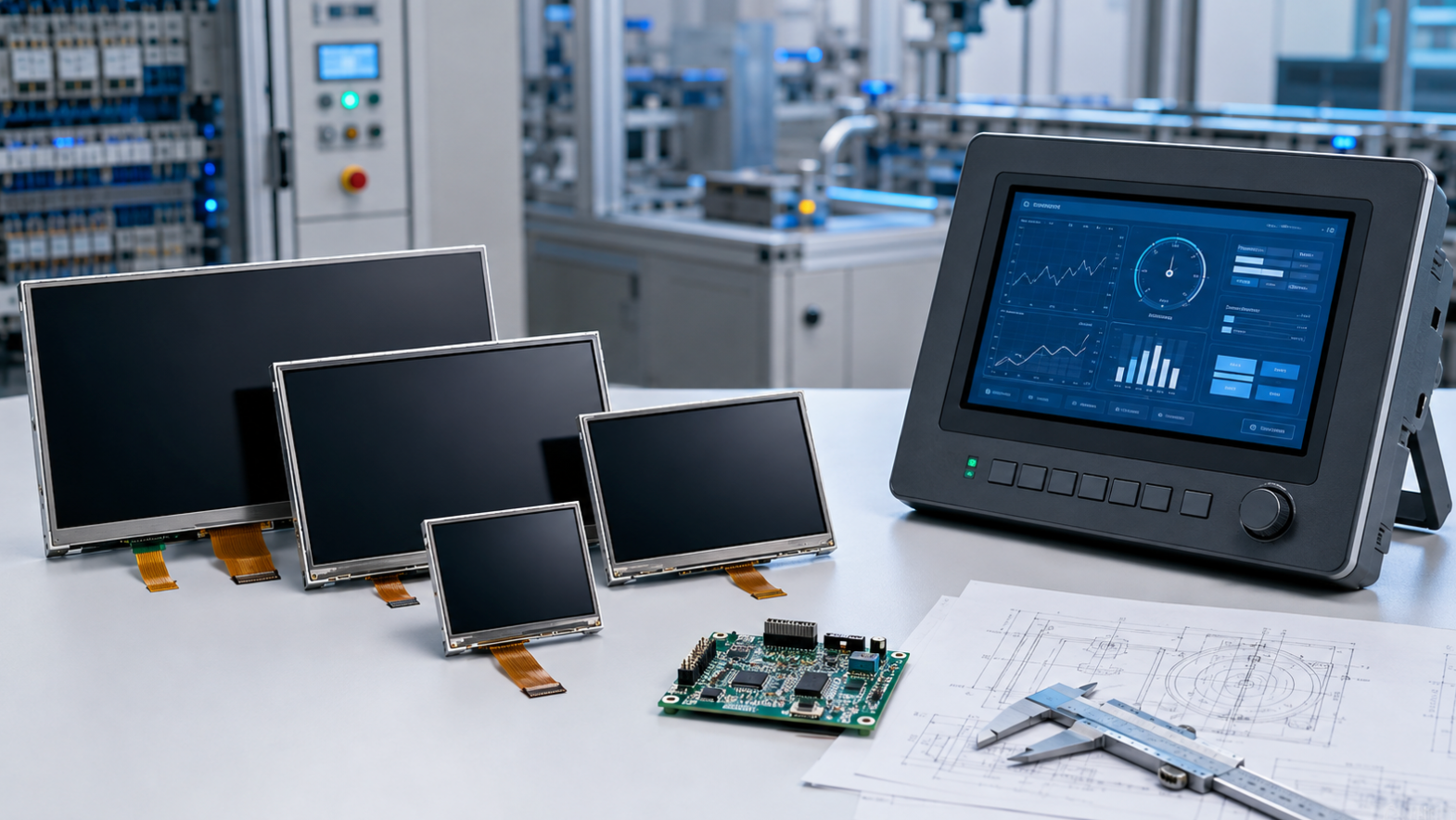
A higher-resolution display is useful only when the host can render and deliver the required interface smoothly. Before selecting a panel, estimate graphics memory, understand the data path and run a representative demonstration on the intended hardware.
1. Calculate the image buffer
For an uncompressed framebuffer, required bytes = pixel width × pixel height × bits per pixel ÷ 8. An 800 × 480 image stored as RGB565 uses 800 × 480 × 16 ÷ 8 = 768,000 bytes, or 750 KiB. Two such buffers require 1,536,000 bytes, approximately 1.46 MiB. These figures cover the pixel buffers only, excluding assets, software, alignment and other allocations.
2. Estimate the active-image data rate
At 60 frames per second, reading that RGB565 image once per frame represents 768,000 × 60 = 46,080,000 bytes per second, or 46.08 MB/s. This is an illustrative active-pixel calculation, not a complete memory-bandwidth requirement or an interface clock specification. Timing overhead, bus behavior, graphics updates and other memory users must be assessed separately.
3. Check the complete graphics architecture
Confirm whether the selected module has display memory or requires the host to maintain and stream the image. Identify the framebuffer location, graphics accelerator, interface controller and relevant memory sharing. A host with enough RAM may still lack sufficient usable bandwidth under simultaneous workloads.
4. Test the actual user experience
Run the heaviest expected screen, including animations, transparency, scrolling and frequent data changes. Observe responsiveness while other product functions are active. Inspect tearing and frame consistency using the intended display timing. A static image test establishes much less than a complete interface demonstration.
Frequently asked questions
Does a physically larger screen always need more framebuffer memory? No. Pixel count and stored color format determine the basic image-buffer size, not diagonal size alone.
Can panel color depth differ from framebuffer format? It can in suitable controller architectures; verify the supported configuration.
When contacting HXD LCD, provide the exact host processor, available RAM, display interface and target UI. Ask for module documentation, then confirm graphics feasibility on the host before finalizing resolution.