
Display Technology
Industrial TFT Display Manufacturer: What Buyers Should Look For
Choosing the right industrial TFT display manufacturer requires more than comparing price and screen size. Buyers should evaluate display quality, operating temperature, interface compatibility, customization capability, long-term supply, quality control and technical support. This guide explains the key factors for selecting a reliable industrial TFT LCD display supplier for OEM and industrial applications.
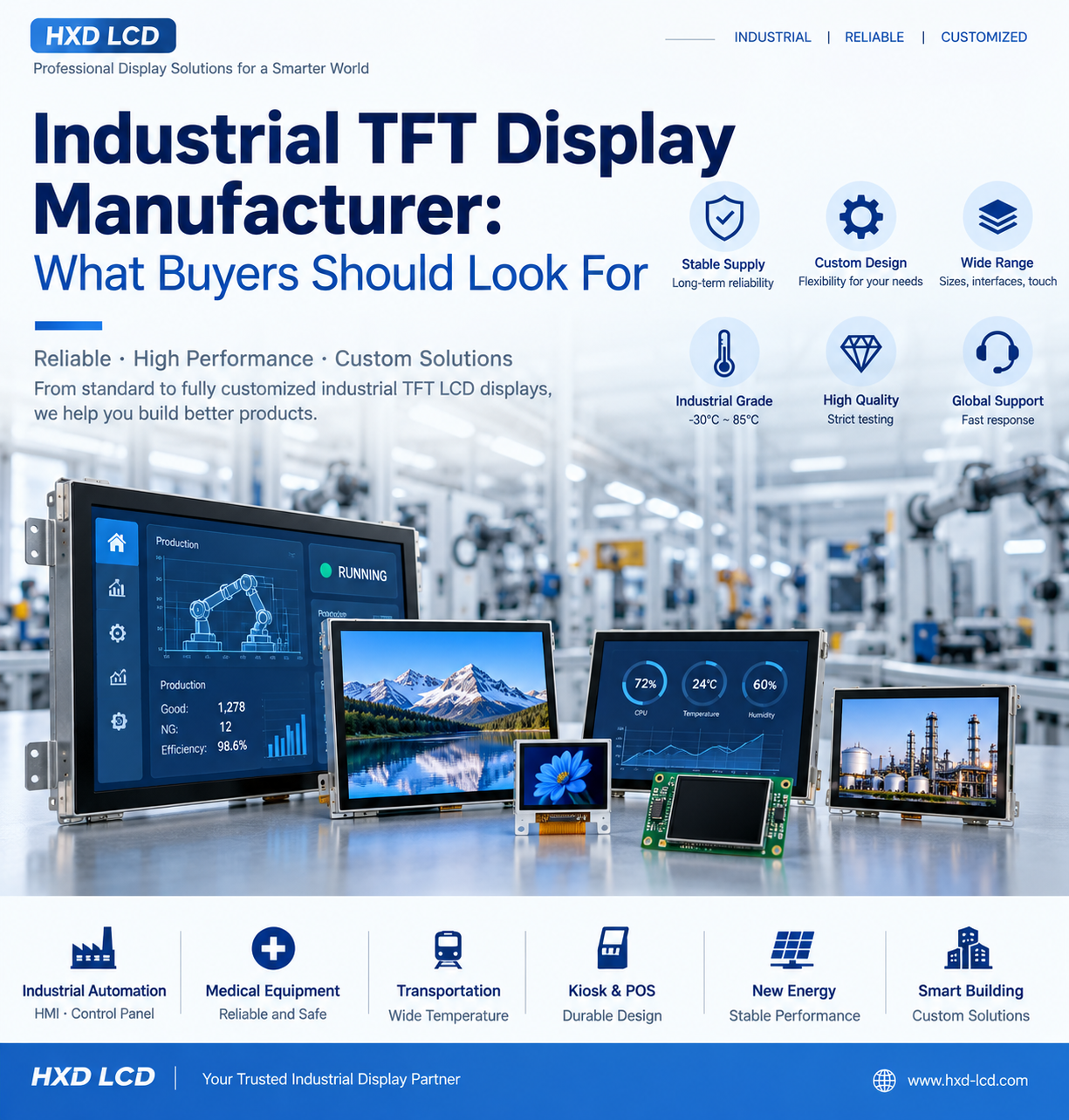
Industrial TFT Display Manufacturer: What Buyers Should Look For
Industrial TFT displays are widely used in industrial automation, HMI systems, medical equipment, transportation, charging stations, kiosks, smart buildings and other professional equipment. Unlike consumer displays, industrial TFT LCD modules often need to operate reliably for long periods under demanding environmental and electrical conditions.
For engineers, purchasing teams and OEM manufacturers, selecting the right industrial TFT display manufacturer is therefore not simply a matter of comparing screen size and price. Product quality, long-term availability, interface compatibility, customization capability and technical support can all affect the success of a project.
Below are the key factors buyers should evaluate when choosing an industrial TFT LCD display supplier.
1. Industrial-Grade Display Quality
A reliable industrial TFT display should provide stable image quality throughout its intended operating life.
Important parameters include:
Resolution Brightness Contrast ratio Viewing angle Color performance Backlight lifetime Operating temperature Storage temperature
The required specification depends on the application. Indoor HMI equipment may use a standard-brightness TFT LCD, while outdoor equipment may require a high-brightness display with improved sunlight readability.
Buyers should define the actual operating environment before selecting a display.
2. Operating Temperature and Environmental Reliability
Industrial equipment can operate in environments that are very different from normal consumer electronics.
Depending on the application, the TFT display may be exposed to:
High or low temperatures Continuous vibration Dust Moisture Direct sunlight Electrical interference Long operating hours
For demanding applications, buyers should discuss operating temperature requirements and environmental conditions with the display manufacturer during the early design stage.
This helps prevent problems after the product enters mass production.
3. Interface Compatibility
Interface selection is one of the most important technical considerations when choosing an industrial TFT LCD display.
Common interfaces include:
RGB LVDS MIPI DSI MCU SPI HDMI
The correct interface depends on the main board, processor and system architecture.
Before confirming a TFT LCD module, engineers should check interface type, voltage, connector definition, timing requirements and mechanical layout.
Working with a manufacturer that can provide technical documentation and engineering support can make system integration easier.
4. Touch Screen Integration
Many industrial TFT display applications require touch functionality.
Common solutions include:
Resistive touch panels Projected capacitive touch panels Cover glass Custom touch sensors Optical bonding
Projected capacitive touch is widely used for modern HMI systems because it provides responsive operation and supports custom cover glass designs.
However, resistive touch can still be suitable for applications requiring glove operation or simple industrial controls.
The appropriate touch solution should be selected according to the equipment's actual operating environment.
5. Custom TFT Display Capability
Standard TFT LCD modules are suitable for many projects, but industrial equipment often requires some level of customization.
Typical customization requirements may include:
Custom FPC Custom connector Backlight modification Brightness adjustment Touch panel integration Custom cover glass Optical bonding Mechanical structure adjustment Interface adaptation
A manufacturer with engineering and customization capability can help OEM customers integrate the display into their final product more efficiently.
This is especially important for projects with specific mechanical, optical or electrical requirements.
6. Long-Term Supply Stability
Industrial products often remain in production much longer than consumer electronics.
A display selected today may need to remain available for several years.
Before choosing a supplier, buyers should consider:
Product lifecycle Component availability Production stability Alternative display options Engineering change communication Long-term supply capability
Stable supply can reduce the risk and cost of redesigning an industrial product because a display becomes unavailable.
7. Quality Control
Consistent quality is essential for industrial TFT LCD applications.
Buyers should evaluate how the manufacturer controls incoming materials, production processes and finished products.
Typical inspection items can include:
Display appearance Brightness Color performance Interface function Touch function Backlight performance Electrical testing Reliability testing
For OEM projects, clearly defined specifications and quality requirements should be confirmed before mass production.
8. Technical Support and Communication
Industrial display projects often require communication between purchasing teams and engineers.
A responsive TFT LCD manufacturer should be able to assist with:
Display selection Datasheets Mechanical drawings Interface information Touch integration Customization requirements Sample evaluation Mass-production coordination
Good technical communication can reduce development time and prevent specification mistakes.
9. Sample Testing Before Mass Production
Before placing a large production order, buyers should evaluate samples in the actual equipment whenever possible.
Testing should confirm:
Mechanical fit Electrical compatibility Display performance Brightness Viewing angle Touch operation Temperature performance System stability
Sample validation allows engineering teams to identify potential problems before committing to mass production.
10. Choosing the Right Industrial TFT Display Manufacturer
The right supplier should be able to support both the technical and commercial requirements of the project.
Instead of selecting a manufacturer based only on the lowest price, buyers should consider the complete value of the display solution, including quality, customization, supply stability and engineering support.
HXD-LCD provides TFT LCD display modules and customized display solutions for industrial and OEM applications. Available support includes different display sizes and resolutions, touch integration, interface options, cover glass, optical bonding and other customization services.
Our display solutions can be used in industrial automation, HMI equipment, medical devices, transportation systems, kiosks and POS equipment, new energy systems and smart building applications.
Need an Industrial TFT Display for Your Project?
If you are developing a new product or looking for an alternative industrial TFT LCD supplier, send us your project requirements.
Please include:
Required display size Resolution Interface Brightness Touch requirement Operating temperature Estimated quantity Application
The HXD-LCD team can help evaluate suitable standard or customized TFT LCD display options for your project.
Contact HXD-LCD to request product information, samples or a quotation.