
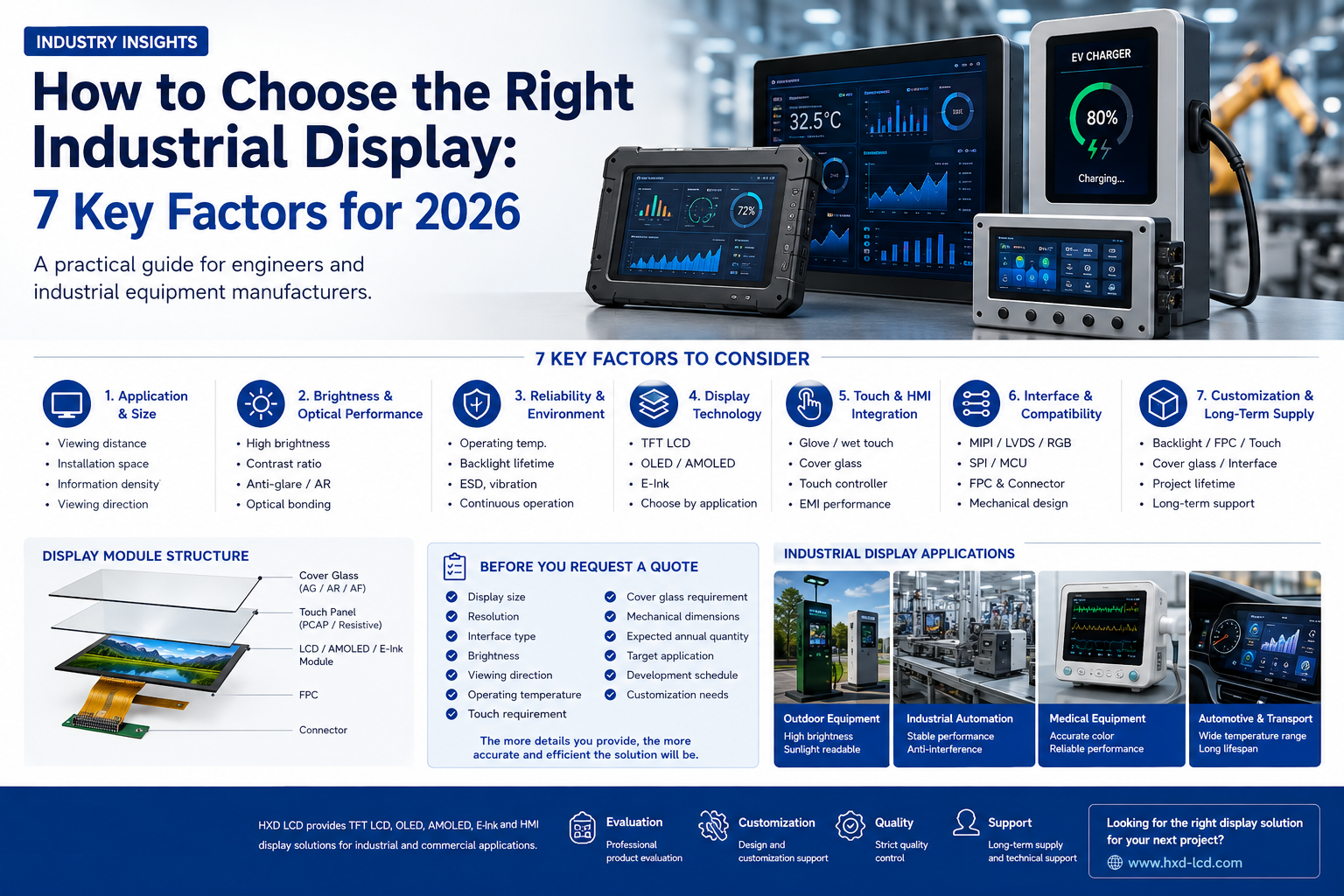
Selecting an industrial display is no longer simply a matter of choosing the right screen size and resolution. For modern industrial equipment, the display must work reliably as part of the complete system, from optical performance and touch integration to mechanical compatibility, environmental reliability and long-term supply.
For engineers and purchasing teams, making the right decision at the beginning of a project can reduce development time, testing costs and potential redesigns. This guide highlights seven key factors to consider when selecting an industrial LCD, OLED, AMOLED or E-Ink display in 2026.
1. Start With the Application, Not the Display Size
The first step is to understand how the display will actually be used.
A 7-inch display may be suitable for a compact industrial controller, while a 10.1-inch or 15.6-inch display may be more appropriate for an HMI, industrial computer or monitoring system. However, size alone does not determine usability.
Engineers should consider:
Viewing distance
Available installation space
Required information density
User interface layout
Indoor or outdoor operation
Portrait or landscape orientation
Required viewing direction
Resolution should also match the application. Higher resolution can provide sharper graphics and more detailed information, but it may also increase system requirements and cost.
The goal is not simply to select the highest resolution available, but to select a display that provides the right balance between image quality, system performance and project cost.
2. Brightness Is Important—But Optical Performance Matters More
High brightness is often considered one of the most important specifications for outdoor or high-ambient-light applications. However, brightness alone does not guarantee good readability.
Real-world readability depends on several factors, including display brightness, contrast ratio, viewing angle, surface reflection, cover glass and ambient lighting.
For outdoor terminals, EV charging stations, transportation equipment and industrial control panels, a high-brightness backlight may be required.
Depending on the application, a display may require 800, 1000 or even higher nits. Anti-glare or anti-reflection treatment can further improve visibility.
Optical bonding between the display and cover glass can also reduce internal reflections and improve perceived contrast.
For indoor industrial equipment, extremely high brightness may not be necessary. Stable color reproduction, wide viewing angles and comfortable brightness levels may provide a better overall user experience.
The right question is not simply “How bright is the display?” but “How clearly can the user see the information in the actual operating environment?”
3. Consider Temperature and Long-Term Reliability
Industrial equipment often operates for many hours every day and may be exposed to conditions that are very different from consumer electronics.
Depending on the application, the display may need to operate under low temperatures, high temperatures, continuous operation, vibration, dust, electrical interference and ESD events.
Important specifications may include operating temperature, storage temperature, backlight lifetime, ESD performance and vibration requirements.
For equipment installed in factories, outdoor cabinets, transportation systems or energy infrastructure, engineers should provide the supplier with the actual environmental requirements before sample development.
A display designed for a normal indoor environment should not automatically be assumed to be suitable for a harsh industrial environment.
Reliability begins with correct application information.
4. Choose the Right Display Technology
Different display technologies have different advantages.
TFT LCD
TFT LCD remains one of the most widely used technologies for industrial equipment because it offers full-color images, fast response, video capability, a wide range of sizes and mature customization options.
It is commonly used in industrial HMIs, medical equipment, measurement instruments, automation systems and control terminals.
AMOLED and OLED
AMOLED and OLED displays can provide high contrast, deep blacks and excellent visual performance in compact applications.
They are particularly attractive when industrial equipment requires a premium user interface, compact form factor or high image quality.
E-Ink
E-Ink is suitable for applications where information changes relatively slowly and extremely low power consumption is important.
Typical applications may include electronic labels, meters, portable instruments and battery-powered information displays.
The best technology depends on the application rather than simply following the latest display trend.
5. Touchscreen Integration Should Be Considered Early
Modern industrial displays are increasingly becoming complete HMI systems rather than simple image output devices.
When selecting a touch display, engineers should evaluate more than basic touch functionality.
Key considerations include:
Glove operation
Wet-touch performance
Cover-glass thickness
Surface treatment
Touch-controller compatibility
EMI performance
Touch accuracy
Multi-touch requirements
For industrial environments, operators may wear gloves or interact with the screen when moisture, dust or other contaminants are present.
Cover glass also affects the mechanical and optical performance of the final product. Thickness, surface treatment and bonding method should therefore be considered during the early design stage.
Integrating the display and touch solution early can reduce the risk of mechanical interference and repeated qualification testing later.
6. Confirm Mechanical and Electrical Compatibility
A display may have the correct size and resolution but still be unsuitable for the final product if its mechanical or electrical design does not match the system.
Before approving a display module, engineers should confirm:
Overall dimensions
Active area
Viewing area
Mounting structure
FPC position
Connector type
Connector orientation
Operating voltage
Interface
Driver IC
Software compatibility
Common interfaces include MIPI DSI, LVDS, RGB, SPI and MCU. Each interface has different characteristics and should be selected according to the processor, bandwidth, resolution and system architecture.
Mechanical integration is equally important. Even a small difference in FPC position, connector orientation or mounting dimensions can create problems during final assembly.
For this reason, a complete mechanical drawing should be reviewed before mass-production approval.
7. Think About the Entire Product Lifecycle
Industrial products often have significantly longer lifecycles than consumer electronics.
A machine may remain in production for several years, while the display used inside it must continue to be available for maintenance and replacement.
This makes supply-chain planning an important part of display selection.
Before starting mass production, buyers should discuss:
Project lifetime
Estimated annual quantity
MOQ
Lead time
Product revision control
Sample approval
Quality requirements
Replacement strategy
End-of-life management
Long-term supply support
When a standard display cannot fully meet the application requirements, customization may be considered.
Depending on the project, customization can include backlight brightness, FPC design, connector, touch panel, cover glass, optical bonding, interface, mechanical structure, viewing angle and temperature range.
The earlier these requirements are confirmed, the easier it becomes to control development time and production risk.
Before You Request a Display Quotation
To help suppliers recommend the right solution quickly, prepare the following information before requesting a quotation:
Display size
Resolution
Application
Interface
Required brightness
Viewing direction
Operating temperature
Touch requirement
Cover-glass requirement
Mechanical dimensions
Expected annual quantity
Target development schedule
Customization requirements
Providing this information allows the display supplier to evaluate the application more accurately instead of simply recommending a standard catalogue model.
From Display Selection to Production
Choosing the right industrial display is a system-level decision.
The best solution is not necessarily the display with the highest resolution, highest brightness or lowest price. A successful industrial display solution should balance optical performance, reliability, touch functionality, mechanical compatibility, electrical integration, power consumption and long-term supply.
HXD LCD provides TFT LCD, OLED, AMOLED, E-Ink and HMI display solutions for industrial and commercial applications.
From standard display modules and prototype evaluation to touch integration, optical bonding, customized FPC, mechanical customization and volume production, our team works with customers to develop display solutions designed for real-world applications.
Looking for an industrial display for your next project?
Contact HXD LCD with your required size, resolution, interface, brightness and application information. Our team can help evaluate the appropriate display technology and develop a solution based on your project requirements.
HXD LCD — Display Solutions for Real-World Applications.